
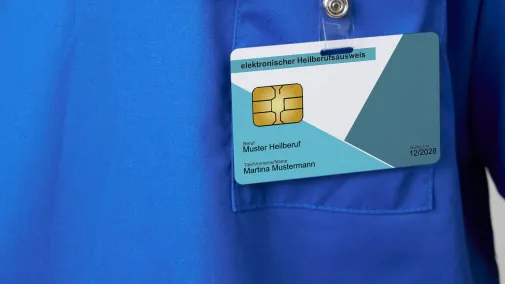
Everything you need to know about the electronic health professional card (eHPC)
With the electronic health professional card (eHPC) healthcare professionals obtain personalised access to the telematics infrastructure (TI). This allows them use of the various TI specialist applications.
Which TI applications can be used depends on the access rights granted to each healthcare profession. The eHPC always includes a qualified electronic signature (QES). It can be used to sign e-prescriptions, electronic certificates of incapacity for work (eAU), invoices or electronic prescriptions. You can order the eHPC from D-Trust, a subsidiary of the Bundesdruckerei Group.
All benefits at a glance
- Secure access to the telematics infrastructure
- Write access to TI specialist applications
- Fast online application; no need to print and post application documents
- Qualified electronic signature (QES), for example for e-prescriptions
- Batch and convenience signatures possible
- Encrypted data exchange
- Access to the electronic patient record
- Identification is possible online via the electronic ID (eID) or in person via PostIdent
Why do you need an eHPC?
The credit card-sized eHPC contains a microchip that stores personal data and is used for authentication. This is necessary to use the TI applications and to exchange documents and data via this network. It also includes encryption and signing functions. This allows, for example, medical letters, test results and e-prescriptions to be exchanged digitally and signed electronically with legal effect.
The eHPC for doctors and pharmacists features a photo. This makes it a photo ID that allows identities to be checked at a glance.
In addition, the card is required in some sectors to order the SMC-B – the practice and institution card. The SMC-B is an essential second component that authenticates the facility as authorised to use the telematics infrastructure.
The eHPC includes encryption and signing functions. This allows, for example, medical letters, test results and e-prescriptions to be exchanged digitally and signed electronically with legal effect.

The eHPC is required in these cases

The electronic health professional card is mandatory for many professions in the healthcare sector. However, not all staff require an eHPC: Access to the telematics infrastructure, and thus to patient data, is granted via the SMC-B smart card.
The eHPC is also required when certain services are provided digitally. This is the case, for example, when the electronic patient record is updated, an electronic certificate of incapacity for work (eAU) is issued, or the emergency data set is signed. Anyone who provides such services must sign them personally using the electronic health professional card.
For health professions that are organised through professional chambers, these act as the card issuer. For applicants from other healthcare professions, the Electronic Health Professions Register (eGBR) acts as the card issuer. Pharmaceutical engineers, pharmacy assistants and EU mail-order pharmacists apply to gematik, the National Agency for Digital Medicine, for their eHPC.
On the D-Trust website, a subsidiary of the Bundesdruckerei Group, you can find detailed information on how to make optimal use of telematics infrastructure features in your professional field.











These applications can be used with the eHPC
With the health professional card, legally binding electronic signatures (qualified electronic signature, QES) can be created. KIM (communication in healthcare) is used as an encrypted service for sending and receiving messages and attachments such as laboratory data or X-ray images, as well as treatment or cost plans.
Which TI applications can be used with the eHPC depends on the access rights granted to the professional group. Medical staff can view only as much information as they need to provide care for patients. With the electronic health professional card, healthcare staff can securely authenticate themselves in order to use TI specialist applications.
These applications include:


Key products related to the eHPC



Frequently asked questions about the electronic health professional card
Digitalisation is changing many processes in the healthcare sector. This gives rise to many questions. Here are the answers to some of the most common questions about the eHPC.
Different issuers are responsible for the eHPC depending on the healthcare profession.
The electronic health professional card is ordered from trust service providers (TSPs) such as D-Trust, a company of the Bundesdruckerei Group. D-Trust produces the eHPC and then dispatches it.
The delivery time for the eHPC is about ten days after D-Trust has received all the required documents. This means thatthe application has been completed online, identification has been successfully carried out, and D-Trust has received approval from the responsible card issuer. Once the eHPC has been sent by registered mail, you will receive a separate registered letter about three days later containing the PIN (and PUK), which is used to activate the smartcard in the card terminal.
During periods of very high order volumes, delivery may take longer.
To unlock your eHPC, you need your reference number and your password (as shown in your application). You can unlock your eHPC in the D-Trust eHealth Application Portal under the option “Open my created applications”. By unlocking it in the D-Trust eHealth Application Portal, you notify us that you have received your card.
Activation via a card terminal is then required. Activation is performed via your primary system. Only after this step is your eHPC ready for use with the TI. To activate your eHPC, you need the five-digit PIN from the PIN/PUK letter and a card reader. For safety reasons the PIN/PUK letter from D-Trust is sent by separate post, usually about three days later.
Introduction of the telematics infrastructure involves costs. This applies to card readers and connectors as well as the eHPC and the practice and institution card. Procurement is subsidised through refinancing agreements with the National Association of Statutory Health Insurance Funds. The amount of funding depends on the sector. For detailed information, please contact the card issuer responsible for you.
An overview of the refinancing arrangements is provided by the National Association of Statutory Health Insurance Funds.
Trust service providers (TSPs) such as D-Trust, a company of the Bundesdruckerei Group, produce the electronic health professional cards.
The electronic health professional card is valid for a maximum of five years and cannot be renewed. Afterwards, you must apply for a follow-up card or a new eHPC from another provider. D-Trust will inform you in good time before expiry so that a follow-up card can be ordered.